Telecom taxes are climbing to record highs, and UCaaS resellers who ignore the complexity risk eroding their margins and facing costly audits.
-
Wireless taxes and fees now consume nearly 28% of the average customer's bill, with some states exceeding 36%.
-
UCaaS providers must navigate federal, state, and local obligations across tens of thousands of tax jurisdictions.
-
Telecom tax automation is essential for accurate billing, compliance, and scalability.
-
Partnering with a white-label provider that handles billing and taxation can eliminate administrative burden and protect your bottom line.
If you're reselling UCaaS solutions in 2026, mastering tax compliance can be the difference between sustainable profit and regulatory headaches.
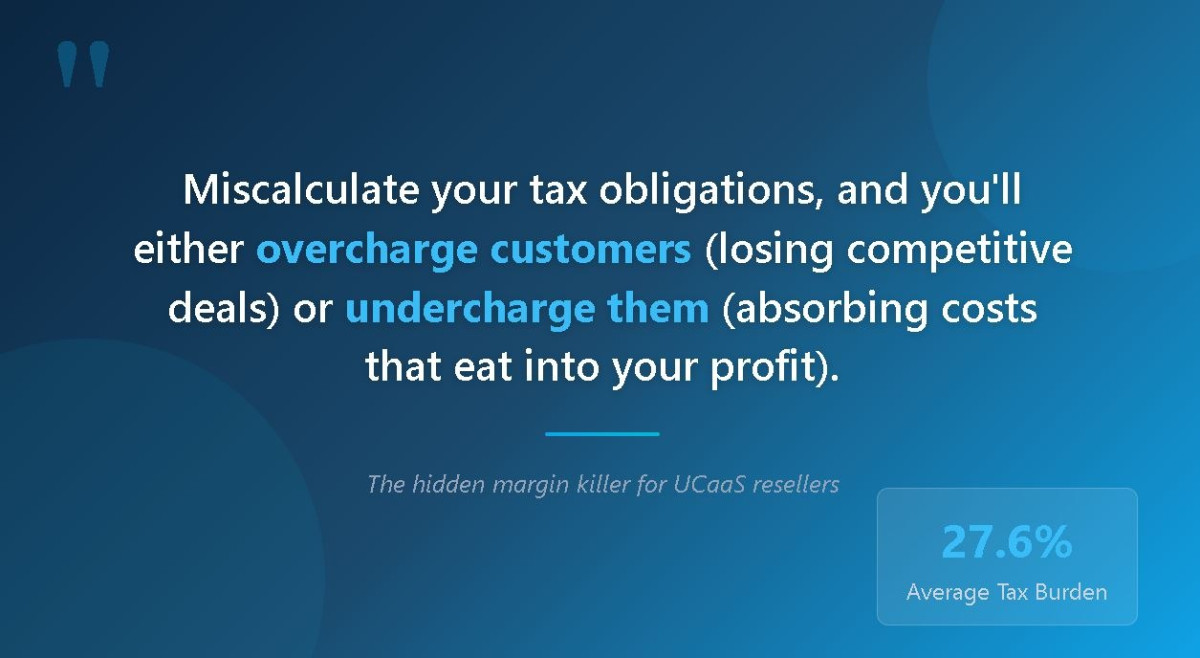
The tax environment for telecom services has never been more demanding. Taxes, fees, and government surcharges now make up 27.60% of the average wireless services bill, marking a record high. That percentage climbed from 26.77% just one year earlier, driven by increasing Federal Universal Service Fund (USF) contribution requirements and incremental state and local tax hikes.
For MSPs, system integrators, and VARs entering or expanding in the UCaaS space, these numbers translate directly into customer-facing pricing decisions and internal margin calculations. Miscalculate your tax obligations, and you'll either overcharge customers (losing competitive deals) or undercharge them (absorbing costs that eat into your profit). Neither outcome supports long-term growth.
This environment rewards resellers who build compliance into their operations from the start. Understanding your obligations, leveraging automation, and strategically partnering are the UCaaS reseller tax tips that separate thriving businesses from those drowning in administrative overhead.
Why Are UCaaS Reseller Tax Tips Vital in 2026?
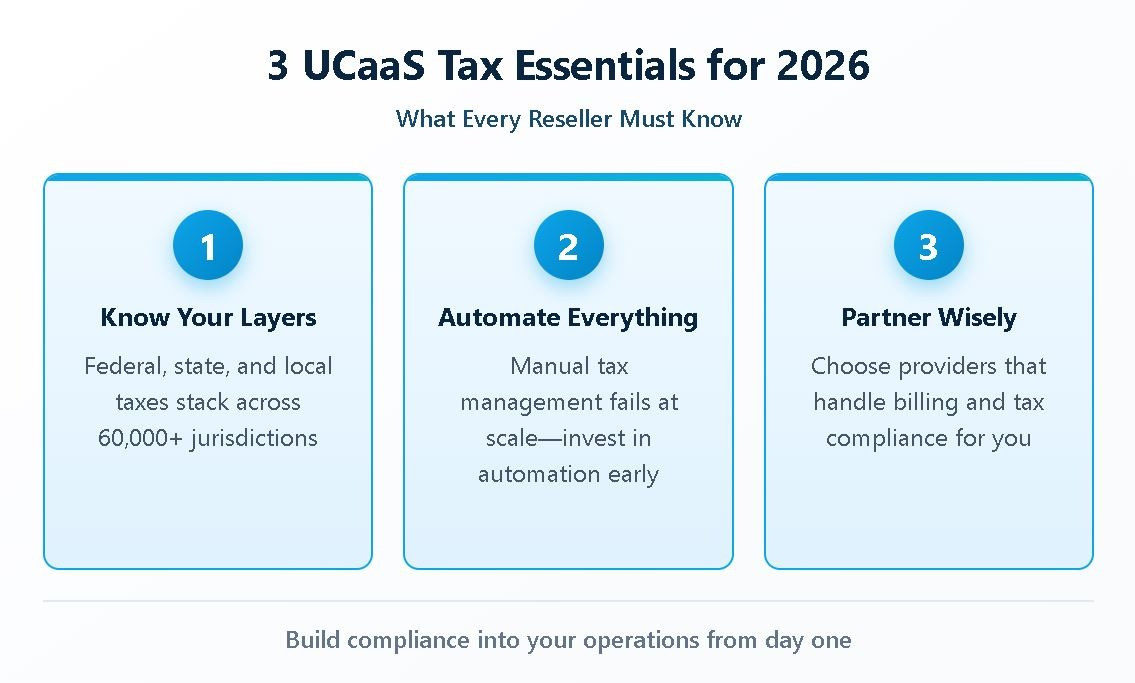
Telecom taxation operates differently from standard sales tax. Where retail goods typically face a single state or local sales tax rate, telecom services can be subject to multiple overlapping layers of federal, state, and municipal impositions. Understanding each layer with UCaaS reseller tax tips helps you build accurate pricing models and avoid compliance surprises.
How Do Federal Taxes and Fees Affect Your UCaaS Business?
At the federal level, UCaaS resellers face several key obligations. The Federal Excise Tax applies a 3% charge on local telephone services. While this tax has historical roots in funding wartime efforts, it remains in effect today and applies to most voice services.
The more significant federal burden comes from USF contributions. All telecommunications providers, including VoIP operators, must contribute a percentage of their interstate and international revenue to the Universal Service Fund. The contribution factor fluctuates quarterly based on fund requirements, and it has reached unprecedented levels. For Q1 2026, the USF contribution factor hit 37.6% of assessable interstate revenues. For every $1,000 in interstate telecom charges, providers now owe approximately $376 to the USF.
Resellers must also maintain FCC registrations, file quarterly Form 499-Q reports, and annual Form 499-A filings, and ensure compliance with STIR/SHAKEN caller ID authentication requirements. The FCC has intensified enforcement around robocall mitigation, requiring providers to demonstrate active compliance rather than passive documentation.
Why Do State and Local Taxes Create Such Complexity?
State and local taxes are the most variable and challenging component of telecom taxation. Telecom providers with national footprints may need to track tax obligations across more than 60,000 federal, state, and local jurisdictions. Each jurisdiction can impose its own rates, rules, and filing requirements.
These differences matter when you're building a telecom reseller business that serves customers across multiple regions. Your pricing strategy in Illinois needs to account for dramatically higher pass-through costs than your pricing in Idaho. Getting this wrong means either sacrificing margin or losing customers who see unexpectedly high invoices.
Local taxes add another layer. California allows local telecom taxes up to 11%. Chicago imposes an additional $5 per line per month in certain circumstances. Baltimore adds $4 per line monthly. These per-line fees, combined with percentage-based taxes, create a maze of calculations that manual processes can't handle accurately at scale.
What Are the Key VoIP Compliance Obligations for Resellers?
Beyond tax calculations and remittance, UCaaS resellers face a broader set of regulatory compliance requirements. Meeting these obligations protects your business from enforcement actions, maintains your ability to operate, and builds trust with customers who expect professional service delivery.
What FCC Requirements Apply to UCaaS and VoIP Providers?
VoIP providers must register with the FCC and maintain active status in the Robocall Mitigation Database. Recent FCC actions have tightened requirements for providers with direct access to telephone numbers, mandating certifications related to robocall prevention, 911 compliance, and Communications Assistance for Law Enforcement Act (CALEA) adherence.
Starting in early 2025, the FCC implemented mandatory Disaster Information Reporting System (DIRS) compliance. Telecommunications and interconnected VoIP providers must now submit detailed reports during FCC-declared emergencies.
Providers must also file annual CPNI (Customer Proprietary Network Information) certification reports. The FCC actively enforces these requirements and has imposed significant fines for missed filings or violations.
How Do USF Contributions Work for VoIP Resellers?
Universal Service Fund contributions represent a high ongoing cost that many new resellers underestimate. The contribution is calculated based on your interstate and international end-user telecom revenues, not your total revenue. You must report these figures quarterly on Form 499-Q and annually on Form 499-A.
The USAC (Universal Service Administrative Company) uses your reported data to calculate your contribution obligation. Payments are due monthly, and contribution rates change every quarter based on the fund's needs. Your tax burden can shift throughout the year, requiring billing systems that can adapt accordingly.
One of the best UCaaS reseller tax tips is to evaluate wholesale VoIP providers based on how they handle USF compliance. Some white-label platforms manage these filings and contributions on your behalf, reducing your administrative burden.
What 911 and E911 Obligations Must You Meet?
Every state imposes 911 fees on telecommunications services, though the structure and rates vary. Some states charge flat per-line fees while others use percentage-based surcharges. These fees fund emergency dispatch systems and must be collected from customers and remitted to the appropriate authorities.
E911 (Enhanced 911) compliance requires that VoIP providers transmit accurate location information to emergency services when customers dial 911. The FCC's Next Generation 911 requirements have expanded these obligations, and providers must maintain evidence of compliance to satisfy regulatory audits.
How Does Telecom Tax Automation Simplify Compliance?
One of the most valuable UCaaS reseller tax tips is automating tax management. Manual tax management becomes untenable as your customer base grows beyond a handful of accounts in a single state. Telecom tax automation applies technology to the calculations, filings, and remittances that would otherwise consume staff time and introduce error risks.
Here's what automated tax systems deliver for UCaaS resellers:
-
Real-time rate application: Automated systems maintain current tax rates across all jurisdictions and apply the correct charges based on service type and customer location without manual lookups.
-
Multi-jurisdiction compliance: A single platform handles the complexity of serving customers in multiple states, counties, and municipalities, each with different rules and filing schedules.
-
Audit-ready documentation: Every tax decision is logged with details on what rate was applied, why, and when, creating the records you need if regulators question your compliance.
-
Bundled service handling: Systems correctly allocate taxes across voice, video, messaging, and data components within bundled offerings, applying appropriate rates to each taxable element.
-
Automated filing and remittance: Sophisticated billing platforms generate required returns and handle payment processing to the appropriate agencies.
The investment in automation pays for itself through reduced error rates, lower audit risk, and the ability to scale operations without proportionally increasing administrative overhead.
What Common MSP Tax Mistakes Should You Avoid?
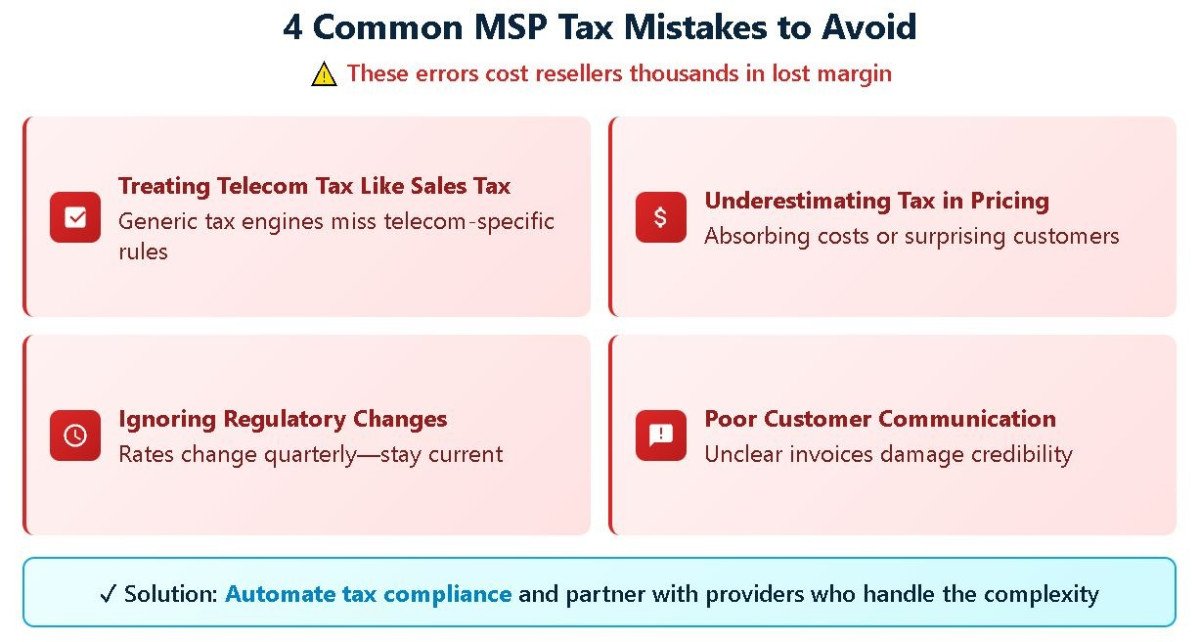
Even experienced resellers make tax-related errors that create liability or erode profitability. Understanding these common MSP tax mistakes helps you build processes that avoid them from the start.
One frequent error involves treating telecom tax like standard sales tax. The rules, rates, and sourcing logic differ. Using a general-purpose sales tax engine for telecom services almost guarantees incorrect calculations and compliance gaps. Telecom-specific tax software exists precisely because generic solutions can't handle the industry's complexity.
Another mistake is underestimating the tax burden when pricing services. If you quote customers based on your wholesale costs plus margin without accurately modeling the tax pass-through, you'll either absorb unexpected costs or surprise customers with higher-than-expected invoices. Neither outcome builds sustainable relationships.
Failing to track regulatory changes creates audit exposure. States frequently adjust 911 fees, USF contribution requirements, and communications tax rates. What was compliant last quarter may not be compliant today. Without systems that automatically update rates, you risk months of incorrect billing before discovering the problem.
Finally, many resellers neglect customer communication about taxes and fees. When customers don't understand the line items on their invoices, they question your credibility. Being transparent about VoIP tax compliance from the sales process forward builds trust and reduces billing disputes.
What VoIP Compliance Best Practices Should You Adopt for 2026?
Success in the UCaaS reselling space requires treating compliance as a core business function. These UCaaS reseller tax tips help you build a sustainable operation that scales without accumulating regulatory risk.
How Should You Structure Your Compliance Operations?
Start by establishing clear ownership of tax and regulatory responsibilities. Whether you handle compliance internally or outsource to specialists, someone must be accountable for monitoring requirements, ensuring timely filings, and maintaining documentation. Ambiguity around ownership leads to missed deadlines and compliance gaps.
Implement systems that separate taxable and non-taxable service components. Many UCaaS bundles include elements with different tax treatments, as voice services often face heavier taxation than pure data services. Your billing system must correctly categorize each component and apply appropriate rates.
Maintain detailed records of all tax calculations, filings, and payments. Audit periods can extend several years back, and regulators expect documentation that supports every tax decision you made. Cloud-based systems with automatic audit trails simplify this requirement.
What Role Does Provider Selection Play in Compliance Success?
Your choice of white-label UCaaS provider affects your compliance burden. Some providers offer turnkey solutions that handle billing, taxation, and regulatory filing on your behalf. Others provide wholesale services that leave all compliance responsibilities with you.
For resellers without dedicated tax and regulatory staff, providers that manage compliance offer compelling value. The monthly cost of outsourced compliance support typically pales compared to hiring specialists or managing the audit risk of doing it yourself incorrectly.
Evaluate providers based on their infrastructure for tax automation, their track record with regulatory compliance, and the support they offer during audits. A provider that has handled hundreds of resellers understands common pitfalls and has built systems to avoid them.
Frequently Asked Questions
How often do telecom tax rates change, and how can I stay current?
Telecom tax rates change frequently, with USF contribution factors updating quarterly and state or local rates adjusting multiple times per year. Manual tracking is impractical for multi-state operations. Successful resellers rely on automated tax systems that maintain current rate databases or partner with providers who handle tax compliance as part of their platform offering.
What happens if I make errors on tax filings or miss a deadline?
Errors and missed deadlines can trigger penalties, interest charges, and increased audit scrutiny. In severe cases, repeated compliance failures could affect your ability to maintain FCC registrations or operate in certain jurisdictions. The consequences vary by agency and severity, but building accurate processes from the start costs far less than fixing compliance problems retroactively.
Can I pass all telecom taxes through to customers?
Yes, most telecom taxes and fees can be passed through to customers as line items on invoices. This is standard industry practice. However, the way you present these charges affects customer perception. Clear, itemized invoices with brief explanations of major fee categories reduce confusion and billing disputes.
What's the difference between handling taxes myself versus using a provider's billing platform?
Handling taxes yourself requires investing in specialized software, maintaining rate databases, filing returns across multiple jurisdictions, and dedicating staff time to management. Using a provider's integrated billing platform shifts much of this burden to specialists who manage compliance at scale. For most resellers, especially those early in their growth, leveraging provider infrastructure delivers better accuracy at lower total cost than building internal capabilities.
Simplify Your UCaaS Tax Compliance
Telecom taxation will only grow more complex as regulations evolve and your customer base expands. Resellers who treat tax compliance as a strategic priority are more likely to build sustainable businesses. Those who treat it as an afterthought face margin erosion, audit risk, and operational headaches that distract from growth.
The right partner makes all the difference. SkySwitch offers white-label UCaaS resellers a complete ecosystem that includes automated billing, integrated tax calculation, and compliance support designed to let you focus on customers rather than paperwork.