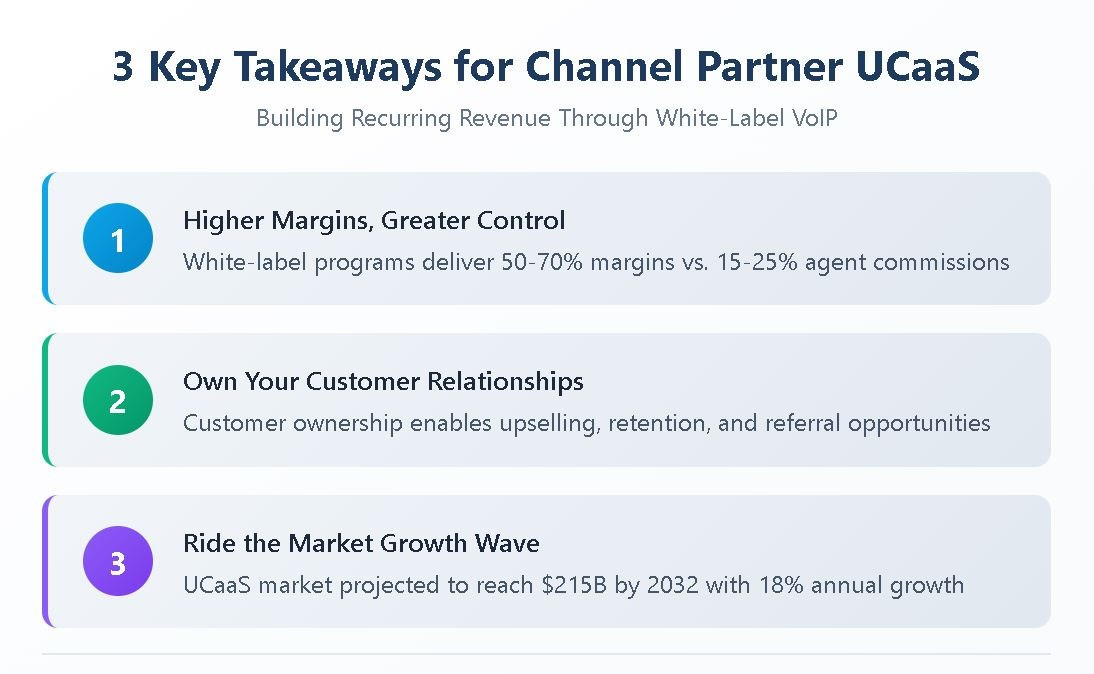
Channel partner UCaaS programs give MSPs, system integrators, and VARs a direct path to predictable, recurring revenue in one of tech's fastest-growing markets.
-
White-label VoIP reselling can deliver 50–70% margins, far exceeding the 15–25% commissions from traditional agent arrangements.
-
The global UCaaS market is projected to grow from $66.42 billion in 2025 to over $215 billion by 2032, creating sustained demand for channel partners in the UCaaS ecosystem.
-
Resellers who own customer relationships gain long-term value through upselling, retention, and referrals rather than one-time payouts.
-
Selling to existing customers has a 60–70% success rate versus just 5–20% for new prospects, making customer ownership a strategic advantage.
If you're still earning referral fees instead of building equity in your own communications business, you may be leaving significant money on the table.
Small and medium businesses are abandoning legacy phone systems at an accelerating pace. They want cloud-based communication tools that support remote teams, integrate with their existing software, and scale without massive capital investments. This shift has created a perfect opportunity for channel partners selling UCaaS solutions.
The global UCaaS market is expanding at an 18.15% CAGR, driven by widespread hybrid work adoption and enterprise demand for consolidated communication platforms. For MSPs, system integrators, and VARs, your existing customer base likely already needs what you could be selling.
The real question is how to enter this market in a way that builds sustainable reseller VoIP revenue rather than one-time commissions that disappear the moment your customer has a bad experience with someone else's brand.
Why Are Channel Partner UCaaS Programs Generating Serious Interest?
The telecom industry has shifted toward cloud delivery. Traditional on-premises phone systems require substantial hardware investments, ongoing maintenance, and technical staff that most SMBs can't justify. Cloud UCaaS eliminates those barriers while delivering enterprise-grade features at accessible price points.
What's Driving SMB Demand for UCaaS?
Your customers are dealing with communication challenges that didn't exist a decade ago. Employees now work from home offices, coffee shops, and client sites. Teams collaborate across time zones using a mix of voice, video, and messaging tools. Legacy phone systems weren't built for this reality.
Modern UCaaS platforms consolidate voice calling, video conferencing, team messaging, and collaboration tools into unified interfaces accessible from any device. This consolidation simplifies IT management while improving employee productivity. By 2028, 90% of organizations will rely on cloud platforms for enterprise telephony, up from roughly 30% in 2025.
For channel partners, this migration presents both opportunity and urgency. Customers who don't buy UCaaS from you will buy it from someone else. Your existing relationships give you an advantage if you act on them.
The Recurring Revenue Advantage
Unlike project-based IT work or one-time hardware sales, UCaaS operates on subscription models that generate predictable monthly revenue. Each customer you onboard contributes to recurring income for as long as they remain satisfied with your service.
This predictability transforms business planning. You can forecast revenue, invest in growth, and build company value based on reliable cash flows rather than hoping the next big project materializes. The subscription model also creates natural opportunities for expansion as your customers grow and add users or features.
What Makes White-Label Channel Sales Different?
Not all channel partner programs offer the same value proposition. Understanding the distinctions between white-label partnerships and traditional referral or agent models helps you choose the approach that aligns with your business goals.
Traditional Agent Models: The Limitations
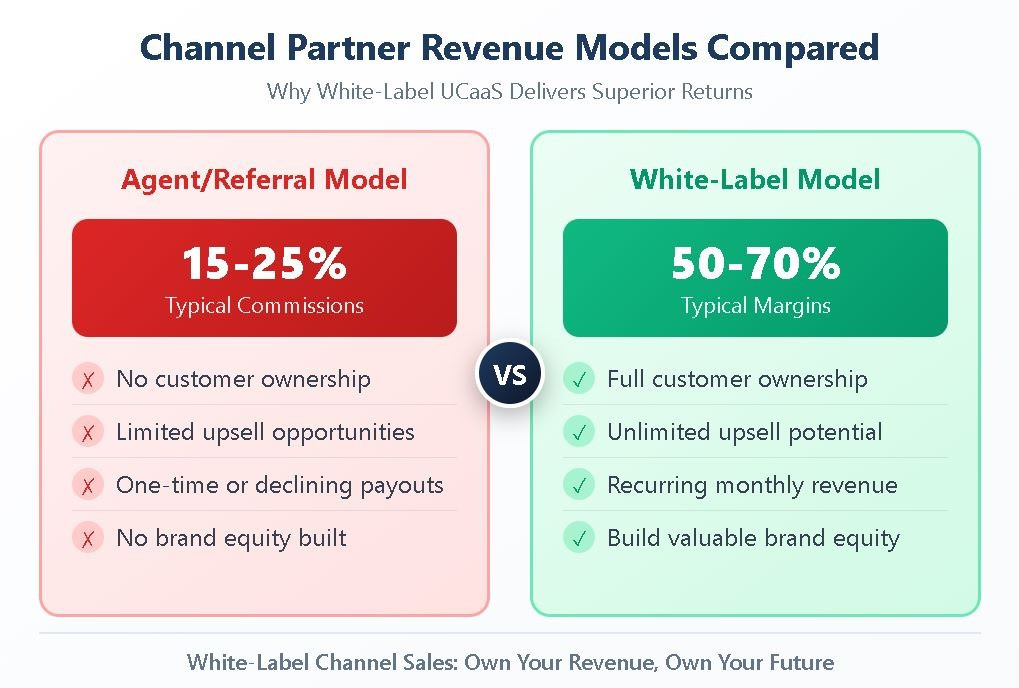
In standard agent or referral arrangements, you introduce customers to a vendor and receive commissions on resulting sales. The vendor owns the customer relationship, controls the service delivery, and puts their brand front and center. Your role is essentially lead generation.
While agent models require minimal investment, they severely limit your earning potential and strategic value. Commission rates typically range from 15–25%, and you have little control over customer experience or retention. When customers call for support, they talk to the vendor's team, not yours. If that experience disappoints, your reputation suffers even though you have no ability to fix the problem.
White-Label Channel Sales: Building Your Brand
White-label channel sales flip this dynamic. You purchase services at wholesale rates from a platform provider, then brand and resell them as your own offering. Customers see your company name on portals, invoices, and support interactions. You control pricing, packaging, and the overall service experience.
This approach can deliver margins of 50–70% depending on your pricing strategy and service packages. More importantly, you build equity in your own brand rather than strengthening another company’s brand. Customers become loyal to your company, not a vendor they've never heard of.
The tradeoff involves greater responsibility. You provide first-line support, manage customer relationships, and own the outcomes when issues arise. For partners who value customer relationships and want to differentiate beyond price, this responsibility is actually an advantage. You can deliver personalized service that large vendors can't match.
How Can I Build Reseller VoIP Revenue That Lasts?
Sustainable channel partner UCaaS success requires strategies for retention, expansion, and operational efficiency that compound your efforts over time.
Customer Retention Drives Profitability
Acquiring new customers costs more than retaining existing ones. The success rate for selling to existing customers ranges from 60–70%, while closing new prospects sits between 5% and 20%. Every customer you lose results to lost revenue and wasted acquisition investment.
UCaaS naturally supports retention when delivered well. Customers depend on their communication systems for daily operations, creating switching costs that discourage churn. Adding multiple services from a single provider further strengthens these relationships. When you handle voice, video, messaging, and potentially contact center needs, competitors must displace everything to win the account.
Expansion Revenue Opportunities
Most UCaaS customers start with basic configurations and gradually add capabilities as they recognize value. Proactive customer success practices identify these expansion opportunities before customers go searching elsewhere.
Consider a small business that initially needs basic cloud phone service for ten employees. Six months later, they've hired remote workers who need mobile access. A year later, they may be ready for a contact center solution to handle growing customer service volume.. Each evolution adds recurring reseller VoIP revenue from a customer you've already acquired.
Offering flexible UCaaS solutions that scale with customer needs positions you as a long-term partner rather than a transactional vendor. This relationship-focused approach generates higher lifetime customer value while reducing competitive pressure.
Operational Efficiency Through Automation
Managing billing, provisioning, and support for a growing customer base requires efficient systems. The right platform partner provides tools that automate routine tasks, freeing your team to focus on customer relationships and sales.
Look for quote-to-cash workflows that streamline the sales process from initial proposal through billing setup. Automated provisioning ensures new services activate quickly without manual configuration errors. Integrated reporting gives you visibility into customer usage patterns and revenue trends.
These operational efficiencies directly impact profitability. Less time spent on administrative tasks means more time available for revenue-generating activities. Fewer manual processes mean fewer errors that frustrate customers and require correction.
5 Must-Have Features in a Channel Partner UCaaS Platform
Choosing the right platform partner shapes your success in white-label channel sales. Not all providers offer equivalent value, and the differences become apparent only after you've committed.
When evaluating channel partner UCaaS opportunities, prioritize these essential capabilities:
-
Complete white-label branding: Portals, mobile apps, invoices, and support documentation all carry your branding exclusively. Half-measures that expose the underlying provider undermine your brand-building efforts.
-
Comprehensive onboarding and training: Entering the UCaaS market requires new knowledge regardless of your IT background. Quality partners invest in structured onboarding programs that teach you to sell, provision, support, and bill effectively. Ongoing training keeps your team current as platforms evolve.
-
Reliable infrastructure with redundancy: Your customers depend on their phone systems for business-critical communications. Geo-redundant infrastructure with automatic failover ensures service continuity even when individual components fail. Ask about uptime guarantees and the technical architecture that supports them.
-
Flexible pricing and packaging control: Your market position requires pricing flexibility. The best partners let you create custom packages, set your own rates, and structure deals that win competitive situations. Rigid pricing tiers limit your ability to serve diverse customer needs.
-
Integrated billing and tax compliance: Telecommunications billing involves complex regulatory requirements, including telecom taxes and compliance filings. Platform partners who handle these complexities reduce your operational burden and compliance risk.
How Can I Position My UCaaS Offering for Growth?
Having access to a quality platform is only the starting point. Successful channel partners develop go-to-market strategies that differentiate their offerings and communicate clear value to target customers.
Know Your Target Market
Generic positioning rarely wins competitive deals. Understanding specific customer segments allows you to craft messaging that resonates with their unique challenges. A dental practice has different communication needs than a law firm or a manufacturing company.
Consider which industries you already serve and understand well. Your existing expertise provides credibility when discussing how UCaaS solves industry-specific problems. Vertical specialization also simplifies marketing since you can focus resources on reaching defined audiences rather than broadcasting to everyone.
Package Services Strategically
Successful resellers create tiered service packages rather than offering à la carte pricing for every feature. Bronze, silver, and gold tiers (or similar naming) give customers clear choices while encouraging upgrades to higher value bundles.
Structure your tiers to address common customer scenarios. Entry-level packages serve price-sensitive buyers with basic needs. Mid-tier options add features that justify modest premiums. Premium packages include advanced capabilities like contact center functionality or extensive integrations that command premium pricing.
Develop Customer Success Practices
Reactive support isn't enough to maximize customer lifetime value. Proactive customer success programs identify opportunities and address issues before they escalate. Regular check-ins, usage reviews, and recommendations demonstrate ongoing value that strengthens retention.
Partnering with a provider that supports your success through training, resources, and responsive support amplifies your customer success capabilities. You shouldn't have to figure everything out alone.
Frequently Asked Questions About Channel Partner UCaaS
What technical expertise do I need to start selling UCaaS?
You don't need deep telecommunications engineering knowledge. Basic familiarity with networking concepts and VoIP fundamentals helps with troubleshooting and customer conversations, but quality platform partners provide comprehensive training that covers essential technical and business knowledge. Most successful resellers come from IT services backgrounds rather than telecom.
How long does it typically take to become profitable as a UCaaS reseller?
Timeline varies based on your existing customer base and market focus. Channel partners with established IT customer relationships often achieve profitability within six to twelve months as they convert existing accounts. New practices without established relationships typically require twelve to eighteen months to build sufficient recurring revenue.
Can I offer UCaaS alongside my existing managed services?
Absolutely. UCaaS complements managed IT services naturally. Customers who trust you with network management, cybersecurity, and cloud infrastructure often prefer consolidating communications with the same provider. Bundled offerings increase average revenue per customer while creating stronger competitive barriers.
Take the Next Step Toward Recurring Revenue Growth
The channel partner UCaaS market rewards partners who act decisively. Every month you delay entering this space, competitors establish relationships with customers you could have served. The technology infrastructure, training programs, and partner support available today remove traditional barriers to entry.
Building a sustainable reseller VoIP revenue stream requires the right foundation. SkySwitch provides the white-label UCaaS platform, comprehensive onboarding, and ongoing support that channel partners need to succeed.